


Three Fields of Study, One Academic Path. What Are Individual Interdisciplinary Studies (ISM) at the Faculty of Economics of the University of Gdańsk Like?
Is it possible to study International Business, Diplomacy, and Art History at the same time, design your own curriculum, take courses offered by several universities, and develop your academic interests under the guidance of a tutor?
At the University of Gdańsk, the answer is yes.
Individual Interdisciplinary Studies (ISM) demonstrate that university education can be much more than following a predefined study programme. At the Faculty of Economics of the University of Gdańsk, students create unique interdisciplinary academic pathways tailored to their interests and aspirations.
Franciszek, an ISM student, and his tutor share their experiences and explain what studying within the programme is really like, the opportunities it offers, and why it requires both independence and close cooperation with a tutor.
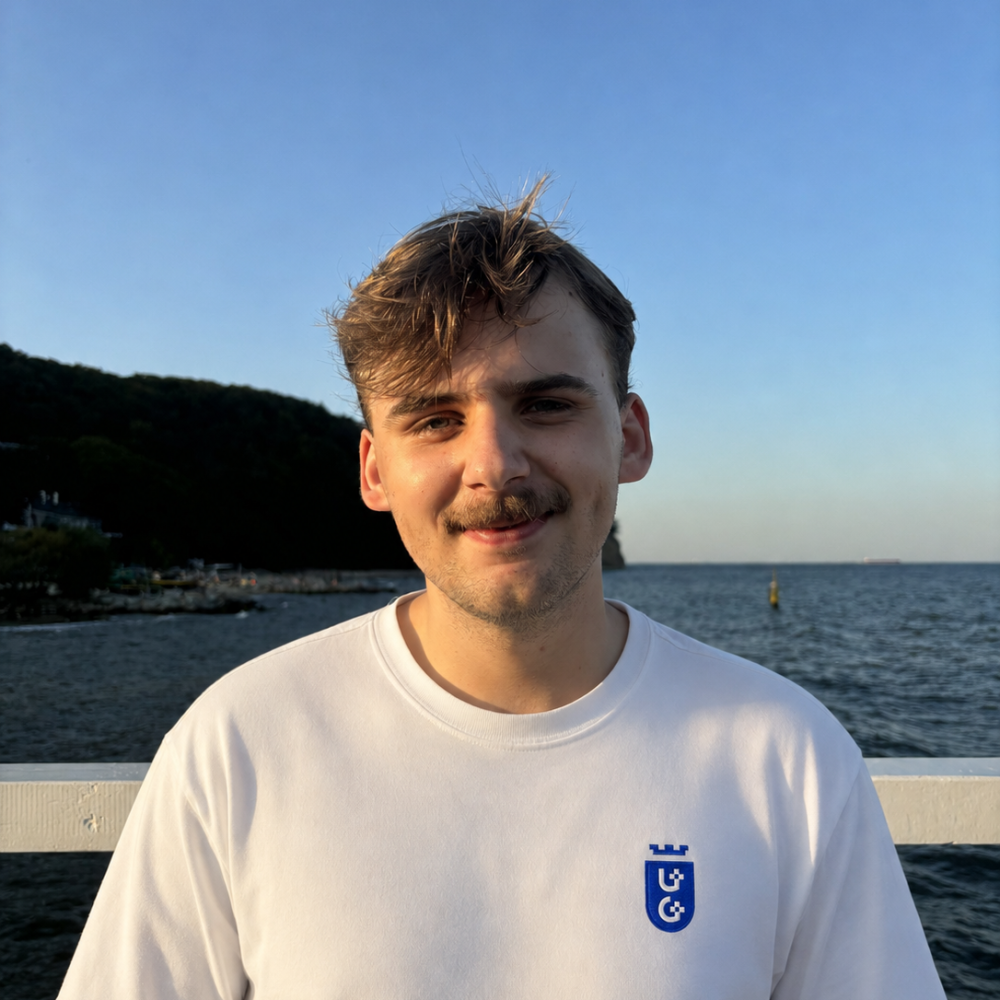
Franciszek Malinowski, a first-year student at the University of Gdańsk enrolled in the Individual Interdisciplinary Studies (ISM) programme:
From the very beginning, I have felt that this mode of study is truly a dream come true for me. I cannot imagine studying in any other way. The programme allows me to pursue studies in three different fields. My primary discipline is International Economics Relations complemented by Diplomacy and Art History.
Studying within the ISM framework perfectly suits my personality and needs. Instead of feeling confined to a single academic discipline, I have the freedom to choose courses from a wide range of fields. This greatly broadens my horizons, allows me to express myself more freely within the university environment, and helps me better understand myself while discovering new interests.
In such an intensive academic environment, a tutor's support is invaluable. Individual meetings with such an experienced member of the academic staff add exceptional depth to university life and naturally have a positive impact on my life beyond the university. My tutor not only guides and motivates me but also genuinely cares about my development and provides support whenever challenges arise. A perfect example of this support is the process of preparing my scientific article for the Student Papers of the Faculty of Economics, University of Gdańsk. In the article, written in April and May, I analysed the strategic importance of maritime chokepoints, such as the Strait of Hormuz and the Strait of Malacca, in the global oil trade. The topic perfectly combines my interests in economics and diplomacy. Thanks to my tutor’s encouragement, guidance, and substantive support, I was able to complete this paper.
Of course, this mode of study also presents certain challenges. The drawbacks include a heavier workload throughout the semester and the need to prepare additional documentation, although I consider designing my own study plan one of the program’s greatest strengths. There are also logistical challenges associated with travelling between faculties. In my case, this means moving between the Faculty of Economics in Sopot, the Faculty of Social Sciences on the Oliwa campus, and the Institute of Art History in central Gdańsk. Combining several fields of study requires a significant amount of work. However, thanks to my tutor’s support and commitment, I can successfully manage these responsibilities.
Another highly valuable element of the programme is the shared courses organised specifically for ISM students. These classes provide an opportunity to spend time with people who have broad intellectual interests and to engage in discussions on interdisciplinary topics, which are always fascinating in such a diverse group. An integral part of our studies is also the annual project. This assignment allows each student to demonstrate what they have learned throughout the year by combining their diverse interdisciplinary interests into a single project, usually in the form of a written paper.
In summary, I wholeheartedly recommend Individual Interdisciplinary Studies. They offer a unique opportunity for comprehensive personal and academic development that would be impossible within a traditional study model. The guidance and support provided by a tutor make even the greatest challenges easier to overcome. I would therefore recommend ISM to anyone who expects more from their studies and wishes to explore and develop their interdisciplinary passions.
Dr Magdalena Markiewicz, Division of International Financial Markets, Department of International Business, Faculty of Economics, University of Gdańsk:
From a tutor’s perspective, Individual Interdisciplinary Studies are one of the educational models that truly demonstrate the value of personalised learning. ISM offers students a great deal of freedom, but it also requires maturity, independence, and responsibility for their own academic path. It is not merely about selecting courses from different disciplines or institutions. More importantly, it is about recognising connections between seemingly distant fields and building a coherent academic profile from them.
My collaboration with Franciszek has been an excellent example of this model's potential. His interests in economics, diplomacy, and art history do not exist separately; rather, they complement one another. It is particularly rewarding to observe the moment when broad interests begin to transform into specific research questions and projects. Together, we concluded that international finance and banking can be combined with diplomacy and art history in many fascinating ways, for example through art investment or through the study of geopolitical changes that influence economic conditions.
The tutor’s role within ISM differs somewhat from the traditional lecturer-student relationship. It is more about jointly designing an academic journey: discussing choices, suggesting possible directions, asking questions, sometimes encouraging students to take on more ambitious challenges, and at other times helping them organise an overwhelming number of opportunities. The ISM model certainly provides many such opportunities, but it also requires determination, motivation, and the ability to overcome obstacles and time constraints. After all, the day still only has twenty-four hours.
Successful cooperation also requires commitment from both sides. Students must learn how to plan, make decisions, manage their time, and take responsibility for their own development. Tutors, in turn, should be able not only to advise but also to give students enough space for independence and accept that their academic path may not always be obvious or linear. In my opinion, this is one of ISM's greatest strengths. These studies teach not only knowledge from multiple disciplines but also intellectual curiosity, the courage to cross boundaries between fields, independence, and the ability to shape one’s own education consciously. They are demanding both organisationally and intellectually, but precisely for that reason they can become much more than the completion of a degree programme. They can become a school of responsibility for one’s own development.
At the University of Gdańsk, we continue to develop tutoring across many areas of academic life, and tutoring itself is an exceptionally rewarding experience. I am therefore especially pleased to have the opportunity to work within the ISM programme. Accompanying a student who consciously seeks their own path, develops new interests, and gradually transforms them into research projects and tangible achievements is one of the most valuable experiences in academic work.